

Issue #26
🔮 Microservices Testing That Doesn't Suck
Microservices testing is broken. You're either waiting weeks for environments, spending team budgets on duplicate infrastructure, or settling for inaccurate mocks that hide real bugs until...

👋 Welcome back, developrrrs! I’m publishing this with minutes to spare before midnight (nothing like a deadline to focus the mind), but if you’re tired of waiting days for test environments or spending budget on duplicate infrastructure, this mesh-based testing strategy could be your team’s DevEx breakthrough.
🤿 Deep Dive
Microservices testing is broken. You’re either waiting weeks for environments, spending team budgets on duplicate infrastructure, or settling for inaccurate mocks that hide real bugs until production. This isn’t just a technical problem – it’s literally costing you money and morale.
🕸️ How Service Mesh Revolutionizes Testing
Here’s the big picture: Start with your existing production infrastructure (or a shared staging environment). In a system with 20 microservices, when you only modify two services, you only deploy those two modified versions. Everything else remains shared. The magic happens through intelligent request routing:
-
Header-Based Traffic Control: Every request gets a special header with your test ID. The service mesh uses this header to decide where to route each request.
-
Dynamic Path Creation: The mesh creates a virtual “path” through the system just for your requests. When your request hits a service you’ve modified, it routes to your version. For all other services, it uses the shared versions.
-
Transparent to Applications: Your applications don’t need any code changes. The mesh handles all the routing logic, making the process completely transparent to your services.
For example, if you’re testing changes to the checkout and payment services, you deploy only those two services. When you make a test request, it flows through the shared cart service, then to your custom checkout service, then to your custom payment service, and finally to the shared notification service, creating an isolated test path through the system.
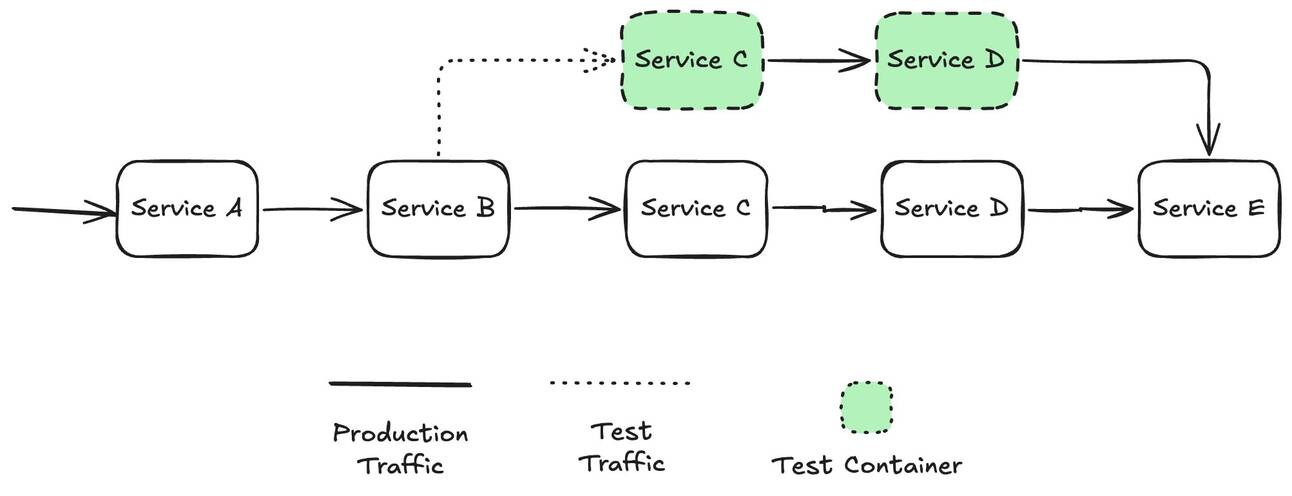
Header-Based Smart Routing
💽 What About Data Isolation?
I can hear you thinking: “This sounds great for routing, but what about data?” The elephant in the room is indeed data isolation. Most implementations handle this through:
-
Database proxies that route queries to test-specific schemas or tables
-
Temporary records with developer-specific tags that get cleaned up automatically
-
Read-from-production but write-to-sandbox data patterns
While data isolation adds complexity, the service mesh approach still significantly reduces the scope of what needs to be isolated compared to full environment duplication.
🚀 Real-World Implementations
This isn’t just theoretical – major tech companies have built their own custom solutions:
Airbnb pioneered service discovery with its SmartStack system that enables automated health checks and request routing.
Lyft implemented “offloaded deployments” with their Envoy service mesh, using request metadata to route traffic to test instances.
Uber created “SLATE” (Short-Lived Application Testing Environment) that leverages header-based routing to create ephemeral test environments.
DoorDash implemented a similar approach for local development, allowing engineers to run modified services locally while connecting to shared dependencies.
Kubernetes-Native Solutions: You can implement this today using:
-
Istio with custom VirtualServices that route based on request headers
-
Linkerd with their traffic split functionality
-
Cilium for network-level request routing and isolation
The implementation pattern is surprisingly consistent:
-
Deploy your modified service with a unique label
-
Configure the mesh to route requests with your test header to your version
-
Ensure header propagation between service calls (most meshes handle this automatically)
-
Add a browser extension or API client plugin to inject your test header
🔗 The DevEx Connection
The impact on developer experience is massive. When every developer can spin up their own test environment in seconds without waiting for infrastructure, you eliminate the biggest DevEx killer in microservices development: waiting. Service mesh testing enables:
-
30-second feedback loops instead of 30-minute (or 30-hour) waits
-
True isolation without duplicate infrastructure costs
-
Real dependency testing without the “it worked on my machine” syndrome
-
Production-like conditions without production-like risks
One platform team I worked with implemented this approach and reduced their testing infrastructure costs by 87% while doubling developer productivity. The ROI wasn’t measured in months or years – it was weeks.
💡 The Bottom Line
Your microservices testing approach can either be your competitive advantage or your biggest productivity killer. To explore service mesh testing further, here are key resources:
-
Learn from Uber’s SLATE: Uber’s Short-Lived Application Testing Environment (SLATE) leverages request-level isolation through header-based routing to create ephemeral test environments. Test requests with special headers are routed to test versions of services while using shared production dependencies, saving massive infrastructure costs.
-
Discover DoorDash’s Approach: Similar to Uber, DoorDash implemented header-based routing to allow developers to preview changes by running microservices locally while connecting to shared environments. This methodology enables testing with real data and dependencies.
-
Study Lyft’s Control Plane: Lyft built a control plane for their shared development environment that enables developers to test microservices without duplicating infrastructure.
-
Watch Airbnb’s Service Mesh Implementation: Learn how Airbnb implemented service mesh technology to enable microservices testing at scale in this detailed technical presentation.
The technology to solve the microservices testing problem exists today—it’s just a matter of implementing the right patterns rather than continuing to throw infrastructure (and money) at the problem.
Stay meshed! 🕸️
Powered by coffee ☕️ and headers that know exactly where to go
📊 Stat
69% of developers lose 8+ hours per week to inefficiencies
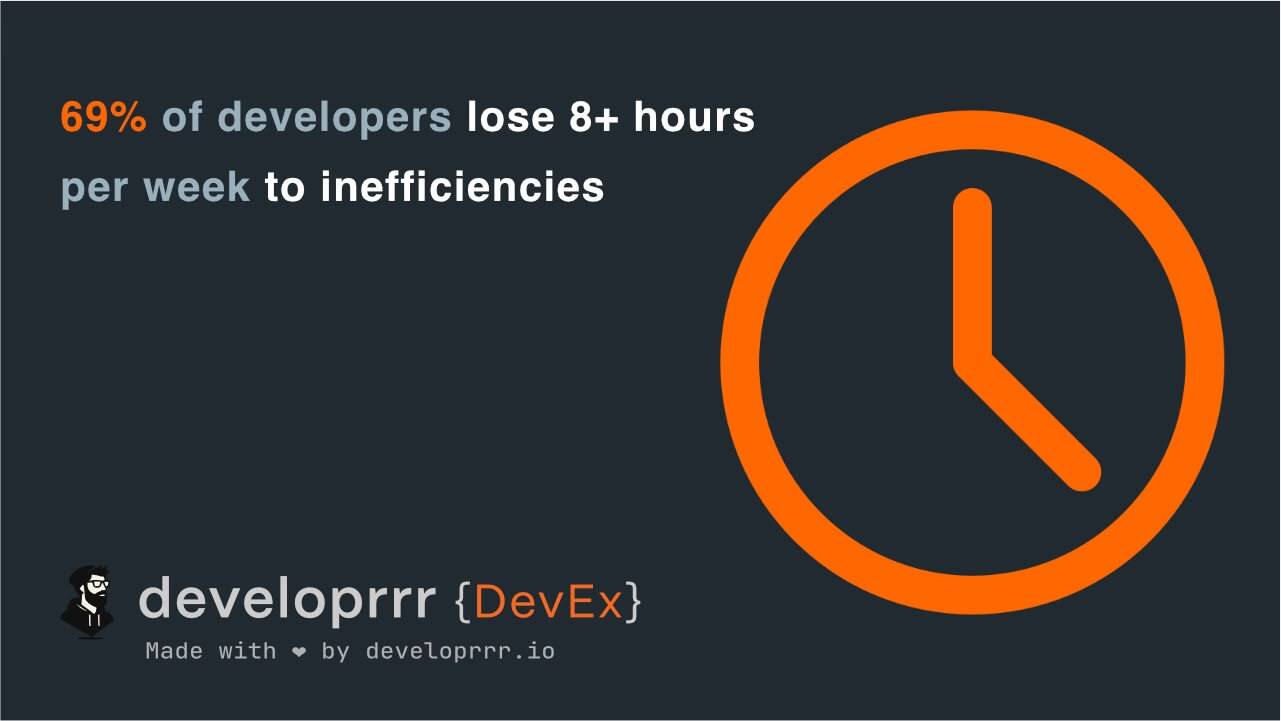
According to the 2024 State of Developer Experience Report, 69% of developers report losing eight or more hours weekly to inefficiencies such as technical debt, insufficient documentation, and complex build processes. Despite this significant time loss, less than half of developers believe their leaders are aware of these issues, highlighting a disconnect that can lead to misaligned priorities and ineffective solutions.
💡 Key Insight: Unaddressed inefficiencies are silently eroding developer productivity and morale.
📌 Essential Reads
👨🏼💻 How Product and Security Teams Can Use GitHub Copilot. GitHub shows how Copilot’s AI assistant now empowers product managers, security engineers, and other “developer‑adjacent” roles to auto‑generate CLI commands, draft documentation, and triage issues. Concrete examples—like turning a plain‑English request into a working tar or grep command—illustrate how it slashes context‑switching overhead and repetitive toil. The article positions Copilot as a cross‑functional force‑multiplier that levels‑up DevEx across the entire software lifecycle, not just inside the IDE.
🚀 GitLab 17.0 Launches CI/CD Catalog & AI Impact Dashboard. GitLab 17.0 debuts a GA CI/CD Catalog of reusable pipeline components, letting teams share proven workflows and speed up delivery. A new AI Impact dashboard correlates GitLab Duo usage with DORA and vulnerability metrics to quantify real productivity gains. Hosted Arm runners, richer deployment pages, and 60 other tweaks round out a release aimed squarely at shortening feedback loops and boosting DevEx.
🔍 DevEx Roundup: JQL Metrics Arrive in Atlassian Compass. March 2025’s Compass update lets teams wire Jira JQL queries directly into custom service health dashboards, bringing issue counts and release readiness data into the IDP at a glance. New auto‑sync for team ownership and smarter alert noise‑reduction further cut glue‑work. Atlassian pitches these features as another step toward a single, low‑friction home for software component insights.
🛠️ Tools
-
DevPod is an open‑source, client‑only Dev‑Environments‑as‑Code tool that spins up reproducible dev containers on any backend from a devcontainer.json, letting developers start coding in seconds while keeping configs in version control.
-
Nixpacks is an open‑source builder that uses Nix to generate deterministic Docker images with zero config, eliminating environment drift and simplifying multi‑language deployments.
-
Vale is an MIT‑licensed prose linter that enforces custom style guides across Markdown and docs to keep documentation consistent in editors and CI.
Get the next issue on Thursday
5-minute weekly reads showing how top engineering teams solve their biggest DevEx challenges and reduce burnout.
Subscribe for freeDelivered every Thursday. Trusted by 3,000+ engineers at companies like Stripe, Google, and Netflix.